The Core Distinction: Executing a Task vs. Owning the HR Function
To establish a scalable business model, executives must conceptually separate performing a people-related transaction from managing HR as an institutional function. When a line manager approves leave or an accountant keys in salary data, they perform isolated transactions—they are not establishing human resources governance.
A transaction is localized and reactive. Institutional HR is proactive and systemic, establishing policy frameworks and legal guardrails to maximize return on human capital while mitigating operational risks. Under Dave Ulrich's 1997 framework, professional HR adds enterprise value through 4 distinct roles:
1. Strategic Partner: Aligning talent structures directly with long-term business goals.
2. Change Agent: Guiding the workforce through mergers and technological transformations.
3. Administrative Expert: Designing lean, standardized workflows that utilize modern technology.
4. Employee Champion: Building a culture of trust and wellness that drives retention.
In mature organizations, these roles are structured through the Three-Legged Stool operating model (HRBPs, COEs, and Shared Service Centers), driving what Deloitte terms Exponential HR.
Distributing HR Responsibilities: What Can Other Departments Execute?
Delegating daily operational activities to line managers does not weaken HR; rather, it is a practical application of strategic business partnering. Line managers can execute specific frontline tasks, provided they operate under policy guardrails designed by HR.
Operational & Financial Risks: Accidental Managers, Compliance, & Data Leakage
Randomly distributing HR tasks breeds the 'Accidental Manager' syndrome—where technical experts are promoted without leadership training (CMI data: 82% of managers lack formal training, 28% of employees resign due to poor managers, and 60% of new managers fail in year 1).
82% lack training; 28% leave due to managers.
Qiwa & GOSI regulatory exposure without HR.
Un-offboarded staff benefits paid silently.
Unsecure spreadsheets violate privacy laws.
Without specialized HR, companies under 100 staff face a 51% higher risk of labor compliance violations. Administrative leakages cost $25,000 to $40,000 annually in un-offboarded employee insurance fees, alongside data breaches under Saudi PDPL laws.
Corporate Evolution Stages, Modern HCM Tech, & Free Consultation CTA
Corporate HR infrastructure evolves across stages: Startup (10-25 staff) relies on HR Outsourcing; Structured Growth (25-50) recruits an in-house HR Generalist; Rapid Scaling (50-100) builds a dedicated team; and Enterprise (100+) deploys Dave Ulrich's 3-Legged Stool model (HRBPs, COEs, Shared Services).

FAQ
Other departments can execute daily tactical tasks (e.g. technical interviews, shift scheduling) under delegated authority, but they cannot own strategic HR governance, policy compliance, legal audits, or labor law risk mitigation.
The Accidental Manager syndrome occurs when technical experts are promoted into leadership without formal management training (82% of managers). This causes 28% of voluntary resignations and a 60% failure rate for new managers in year one.
Companies lacking specialized HR face a 51% higher risk of labor compliance violations, $25,000 to $40,000 in annual benefit leakage for un-offboarded staff, and non-compliance fines under Saudi PDPL data protection laws.
Startups (10-25 staff) use HR Outsourcing (HRO). At 25-50 staff, hiring an in-house HR Generalist is essential. At 50-100, a dedicated team is built, and at 100+ staff, companies deploy Dave Ulrich's 3-Legged Stool (HRBPs, COEs, Shared Services).
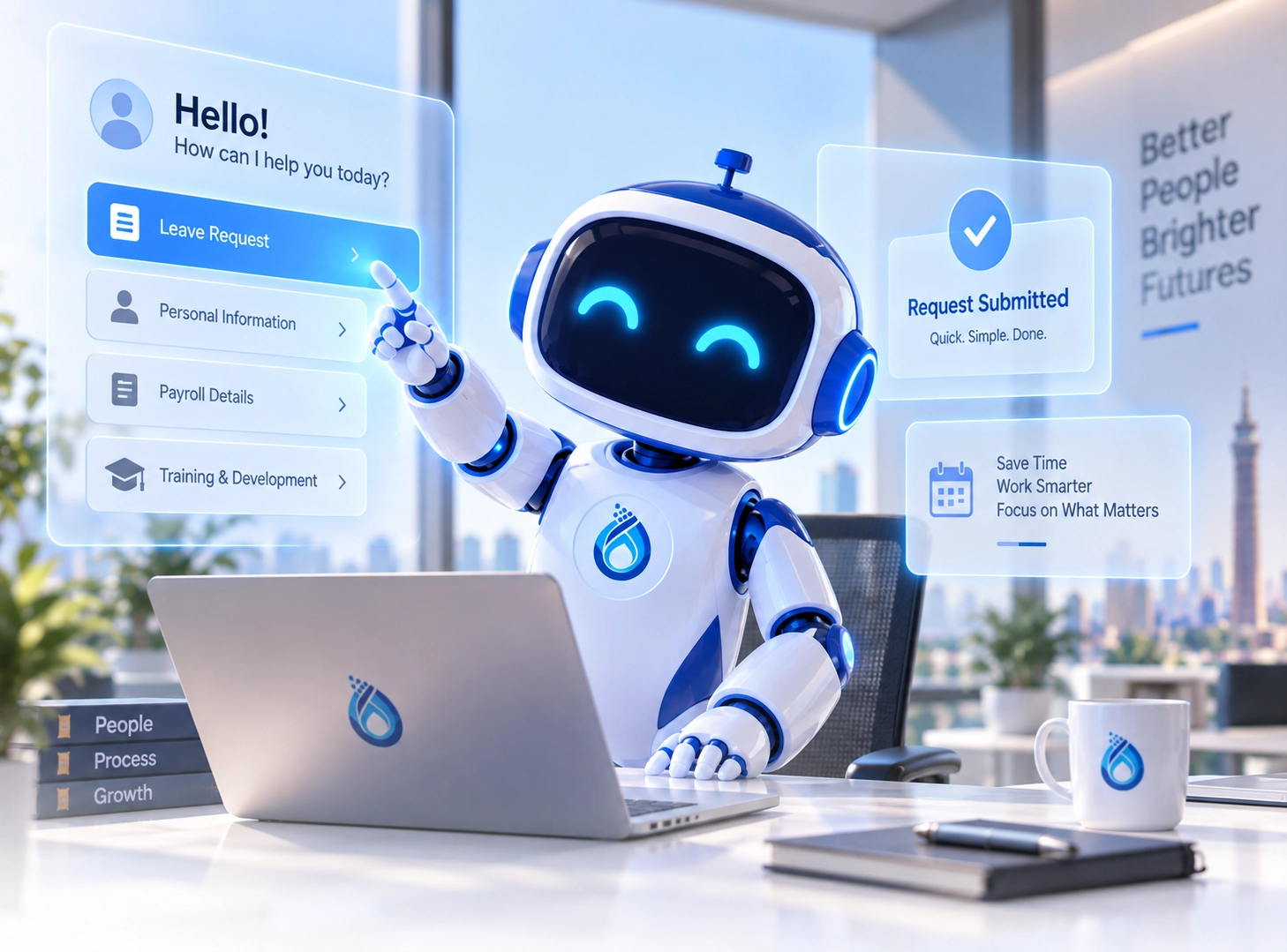
Modern HCM platforms enable Employee Self-Service (ESS) portals so workers can submit leave requests directly, line managers can approve via mobile workflows, and automated system rules enforce policy compliance, automating 50% of routine tasks.
Other Blogs