
- 1. The Bottom-Line Drain: How Manual Time Tracking Erodes Factory Budgets
- 2. Managing 24/7 Overtime Spikes, Shift Fatigue, & Labor Utilization (OLE vs. OEE)
- 3. Automated WPS & GOSI Compliance & Future Factories SIRI Band 2 Gateway
- 4. Operational Blueprint for Agile Workforces & Inspira One HCM Integration
The Bottom-Line Drain: How Manual Time Tracking Erodes Factory Budgets
Many industrial facilities still manage schedules via paper sign-in sheets, Excel spreadsheets, or disconnected legacy systems. The major vulnerability of these manual approaches is their complete lack of real-time validation, which invites costly payroll leaks like 'buddy punching' (clocking in for absent colleagues), time theft, and ghost employees.
Industry data shows that payroll leakage in manual industrial environments ranges between 8% and 12% of the total labor budget. For a factory with 200 workers, unaccounted breaks and manual admin work translate to over $330,000 annually (SAR 1.2+ Million) in unearned wages. Moreover, resolving a single manual timecard edit takes 10 to 20 minutes of administrative effort from line supervisors and HR staff—wasting over 20 hours per week chassing punches instead of optimizing line throughput.
Managing 24/7 Overtime Spikes, Shift Fatigue, & Labor Utilization (OLE vs. OEE)
Operating 24/7 with continuous rotating shifts makes managing overtime impossible without real-time attendance data. Unplanned overtime typically consumes 10% to 15% of labor budgets, spiking past 25% during peak cycles. This leads to elevated occupational accidents (2.7 cases per 100 workers in manufacturing vs 2.3 general average) and scrap rate spikes on the assembly line.
While factories focus heavily on Overall Equipment Effectiveness (OEE), optimizing output requires an equal focus on Overall Labor Effectiveness (OLE), which tracks three key vectors:
- Utilization: Paid hours spent on active, value-adding tasks (industry target: 75%–85%).
- Efficiency: Output pace compared to standard line benchmarks.
- Quality: Percentage of defects-free output on the first attempt (First Pass Yield).
Automated WPS & GOSI Compliance & Future Factories SIRI Band 2 Gateway
MHRSD Wage Protection System (WPS) monitors payroll compliance strictly. Discrepancies between gate attendance and WPS filings bring fines starting at SAR 10,000 per employee and GOSI portal suspensions. Furthermore, digital time tracking serves as the gateway to the Ministry of Industry's Future Factories Program (transforming 4,000 plants), unlocking SIRI Band 2 digital readiness, SAR 300,000 digitization grants (up to 80% coverage), and SIDF automation funding (up to 75%).
Operational Blueprint for Agile Workforces & Inspira One HCM Integration
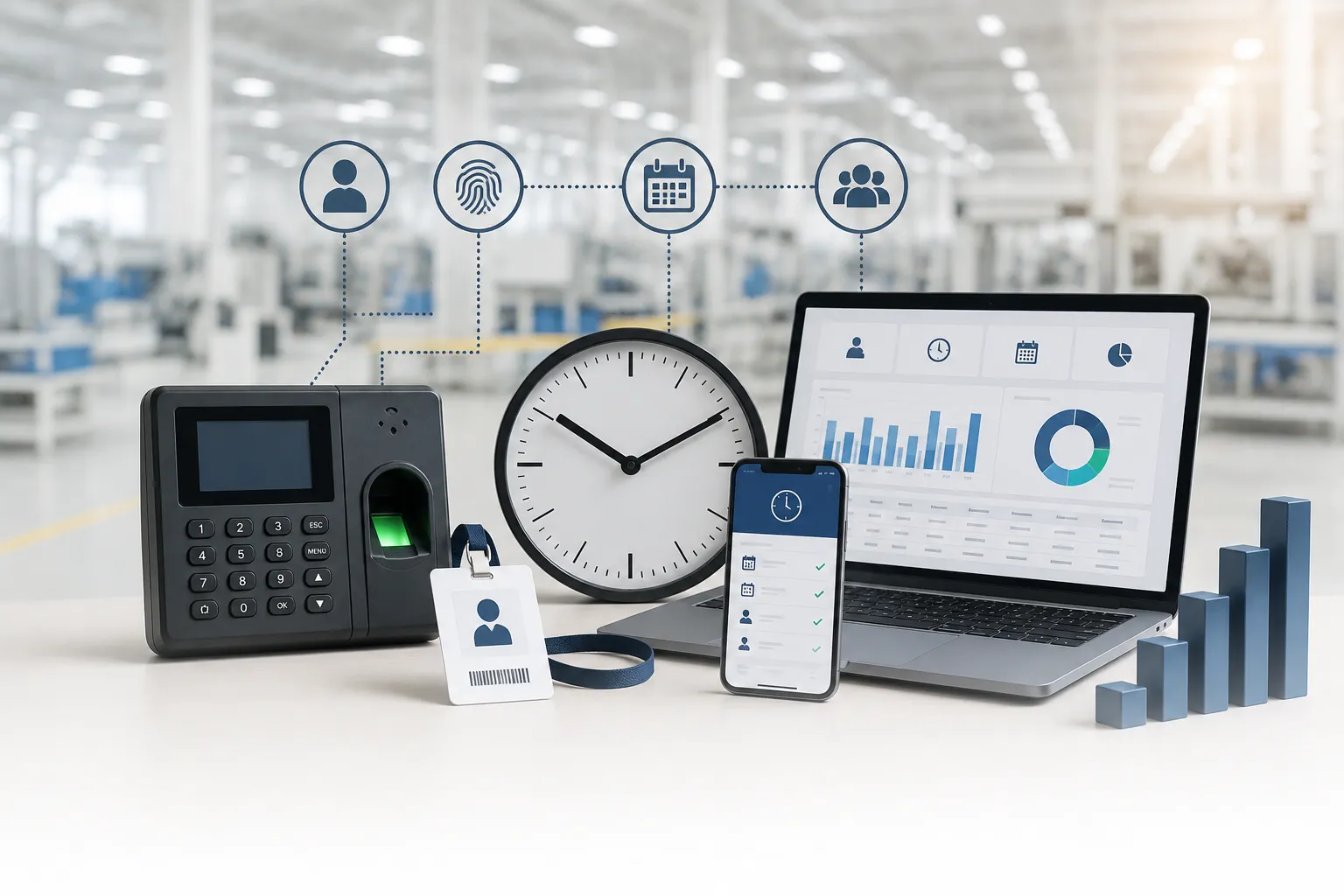
Transforming attendance data into profitability requires an integrated blueprint: dismantle data silos by connecting attendance logs directly with ERP and core HCM; enable 10-minute real-time shift gap discovery via cloud dashboards; and empower workers through mobile self-service apps for leave and shift swaps. Discover how Inspira One HCM by Tidal unifies HR, Finance, and Operations into a single compliant ecosystem engineered for Saudi manufacturing standards.