
- 1. Industrial Logistics, Continuous Shifts, & The Dual Workforce Compensation Paradigm
- 2. Job Evaluation Frameworks & Salary Grade Range Spreads
- 3. Article 107 Overtime Calculations: Basic vs. Actual Wage Math & Shift Rules
- 4. Direct vs. Indirect Labor Burdens, Gainsharing Models, & HCM Payroll Automation
Industrial Logistics, Continuous Shifts, & The Dual Workforce Compensation Paradigm
Factories in MODON industrial cities (Jubail, Yanbu, Sudair, Jazan) operate far from urban residential areas, incurring heavy worker transit and housing costs. Managing 24/7 continuous shift rosters requires mitigating shift fatigue and shift handover coverage gaps.
Job Evaluation Frameworks & Salary Grade Range Spreads
Establishing a scientific salary structure relies on job evaluation. Saudi manufacturers deploy three primary frameworks: Korn Ferry Hay (Know-How, Problem Solving, Accountability for heavy industries), Mercer IPE (5 factors for multinationals), and WTW GGS (7 factors for automated plants).
Establishing a dedicated Technical Career Path allows skilled operators to achieve pay progression based on operational excellence without forcing them into administrative manager roles.
Article 107 Overtime Calculations: Basic vs. Actual Wage Math & Shift Rules
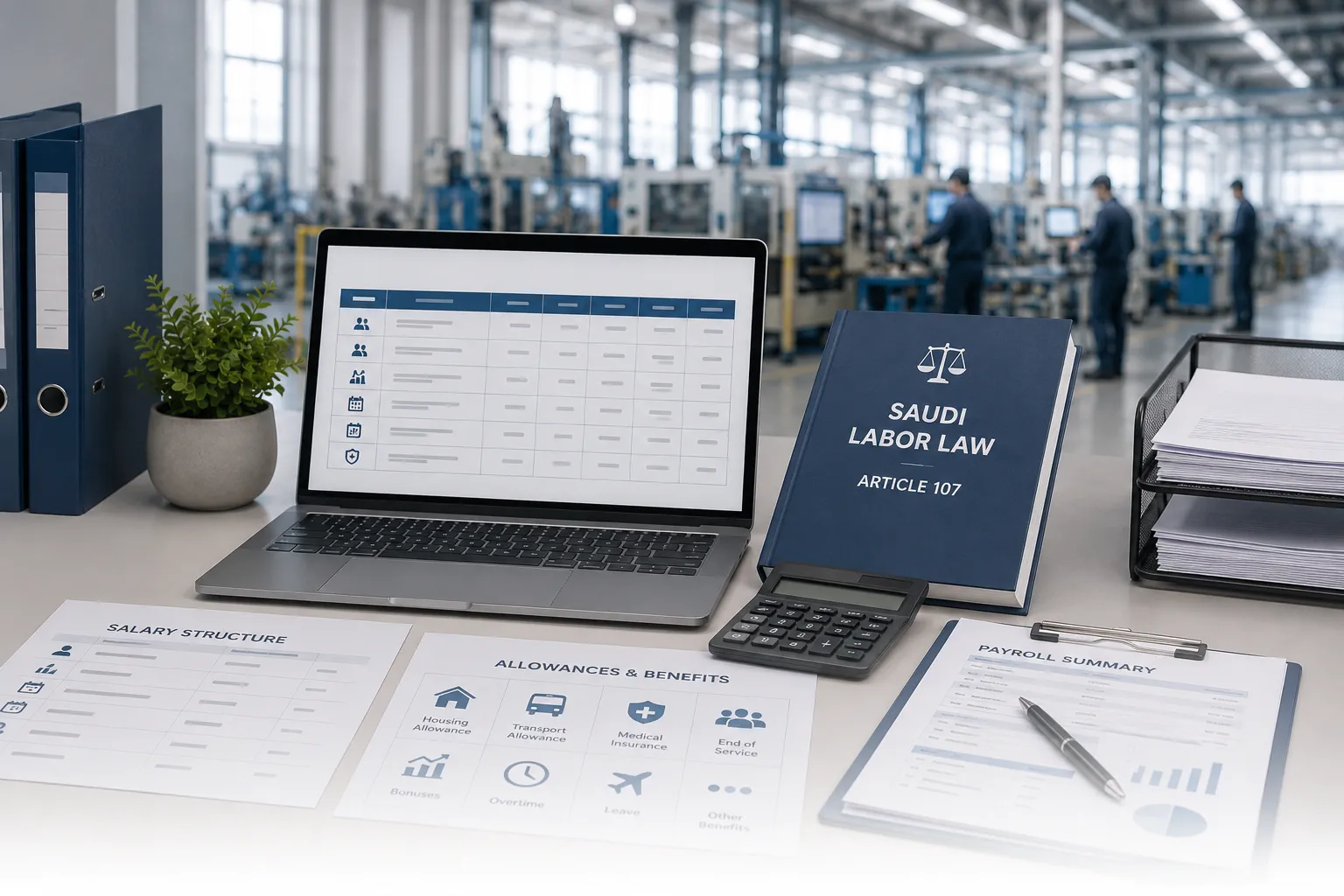
Saudi Labor Law Article 107 mandates paying 1.5x overtime hourly rates based on the Actual Wage (Blended Rate)—including housing and transport allowances—divided by the statutory 240-hour monthly divisor (8 hrs/day × 30 days).
⚖️ Article 107 Overtime Calculation Comparison (SAR 8,000 Basic + 3,200 Allowances)
❌ Basic-Only Method (NON-COMPLIANT)
Divisor: SAR 8,000 ÷ 240 = SAR 33.33/hr
OT Rate: SAR 33.33 × 1.5 = SAR 50.00/hr
High Risk: Triggers MHRSD fines & litigation.
✅ Actual Wage Blended Method (COMPLIANT)
Actual Rate: SAR 11,200 ÷ 240 = SAR 46.67/hr
OT Rate: 46.67 + (0.5 × 33.33) = SAR 63.34/hr
100% Compliant: Protects plant registration.
Shift rules enforce an 11-hour daily maximum work limit, a 720-hour annual overtime cap, 36-hour Ramadan work weeks for Muslims, and allow compensatory time off (1.5 hrs leave per OT hr) within 60 days.
Direct vs. Indirect Labor Burdens, Gainsharing Models, & HCM Payroll Automation
Controlling costs requires distinguishing Direct Labor (variable COGS) from Indirect Labor (semi-fixed MOH). Calculating the Labor Burden Factor (GOSI, medical insurance, Iqama, housing, transport) reveals that total employee costs exceed base salaries by 15% to 25%, with operations targeting a 70% to 80% Time on Task ratio.
Deploying Gainsharing models (Scanlon, Rucker, Improshare) self-funds frontline incentives through waste reduction. localized HCM software (Jisr, ZenHR, Azdan NetSuite) automates Mudad WPS-SIF generation, GOSI & Qiwa sync, biometric shift differentials, and balance-sheet EOSB gratuity accruals—saving SAR 150,000 annually in manual payroll reconciliation.

FAQ
To count as 1.0 full unit in Nitaqat Saudization quotas, a Saudi employee's wage (Basic + Housing) must equal at least SAR 4,000/month. Salaries between SAR 3,000 and SAR 4,000 count as 0.5 unit, and under SAR 3,000 count as 0.
Saudi Labor Law standardizes the monthly divisor at 240 hours (8 hrs/day × 30 days). The compliant Article 107 formula is: Compliant Rate = (Actual Monthly Wage ÷ 240) + (0.5 × [Basic Monthly Salary ÷ 240]).
Article 2 of Saudi Labor Law defines Actual Wage to include basic salary plus all continuous fixed allowances (housing, transport). Calculating OT on basic salary alone violates Article 107, exposing factories to severe MHRSD penalties and retroactive labor claims.
Scanlon rewards reductions in total labor cost relative to sales value. Rucker rewards improvements in value-added index and raw material waste reduction. Improshare rewards team time-savings compared to engineered standard hours.
Localized HCM software automatically formats Wage Protection SIF files for the Mudad portal, syncs GOSI contribution rates (basic + housing), reconciles salaries with Qiwa employment contracts, and processes biometric attendance into overtime engines seamlessly.