

Inspira One HCM

Manufacturing Workforce Performance Management: Headcount to Productivity Under Industry 4.0

In the daily morning operations briefing, a familiar friction plays out: the Plant Manager points to a delayed production board, demanding to know why the facility failed to meet its shipment targets. In response, the HR Manager presents attendance records proving shift headcount is at 100%. Meanwhile, the CFO voices deep concern over labor expenses exceeding the budget due to overtime spikes.

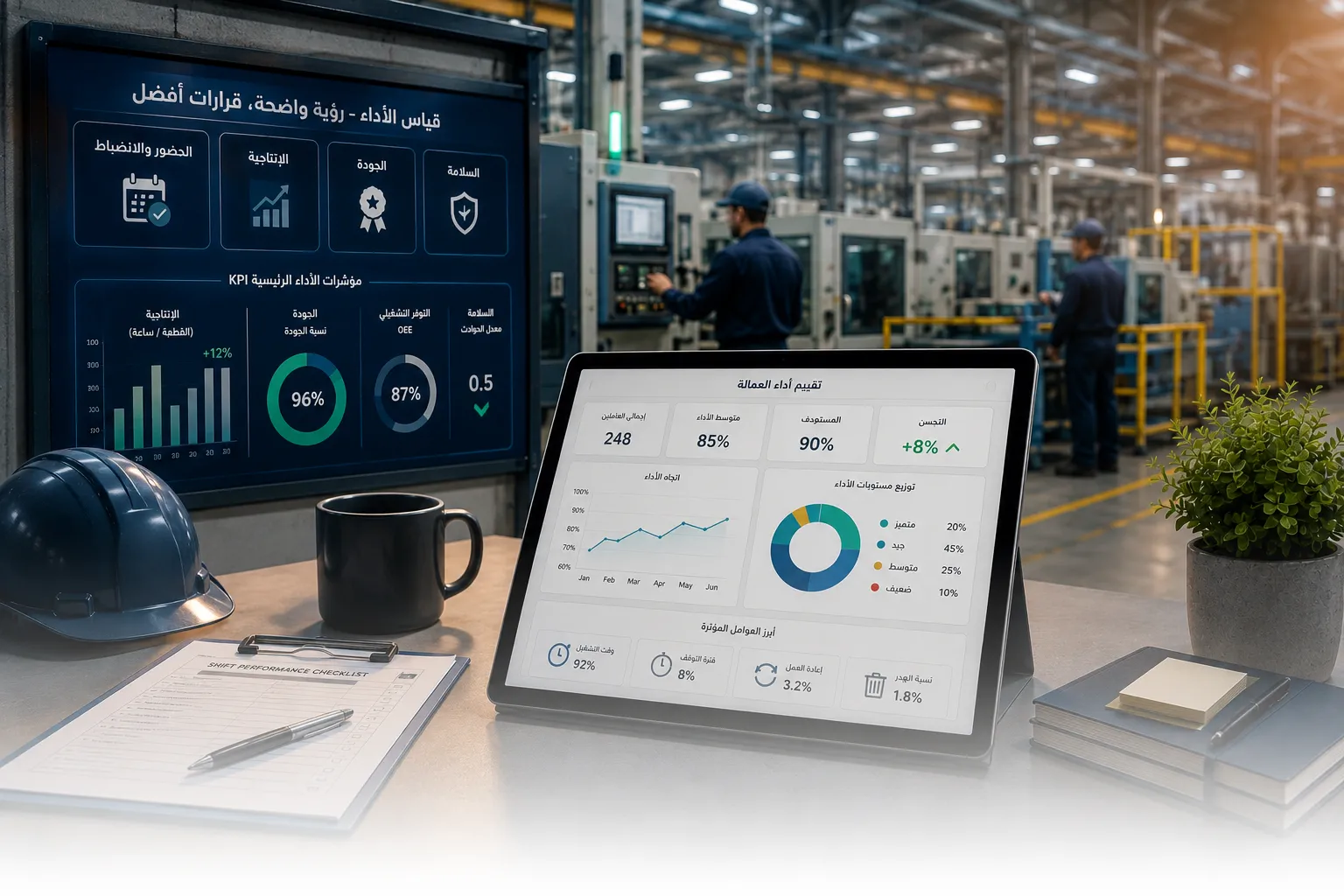
This disconnected dynamic highlights a classic manufacturing failure: the systemic confusion between 'Production' (absolute volume produced) and 'Productivity' (relative efficiency of converting physical and human inputs into quality products). Operating without integrated shop-floor and workforce data forces leaders to make decisions in the dark. This guide provides an operational framework to measure, analyze, and optimize human capital for enhanced profitability.

.
Ahmed Azqlani Ahmed Azqlani
Published: 2026-08-20
Last Updated: 2026-08-20
Read from 5 mins
Manufacturing Workforce Performance Management: Headcount to Productivity Under Industry 4.0

Operational Leakage, 'Shadow Hours', & The Shop-Floor Appraisal Dilemma

Relying on absolute headcount ignores the gap between paid and productive hours, known as 'Shadow Hours' (consuming 30% to 50% of paid time). This waste breeds the 'Hidden Factory'—unseen non-value-adding tasks. McKinsey research proves managing Non-Productive Time (NPT) improves overall efficiency by 15% to 20%.

Furthermore, overworking labor past fatigue limits increases accident risks (12-hr shifts = +37% risk; 60+ hrs/wk = +23% risk). Deloitte data reveals 61% of managers distrust traditional reviews due to 3 flaws: personal bias, the Cobra effect, and conflating underperformance with poor conduct:

AspectUnderperformance (Ability/System Gaps)Poor Conduct (Behavioral Violations)
Observed MetricsSlow cycle times, high defect/scrap rates despite worker effort.High absenteeism, tardiness, refusal to wear PPE, SOP breaches.
Root CausesLack of technical training, outdated SOPs, machine wear, fatigue.Low motivation, disregard for policy, lack of timely consequences.
Prescribed ActionRefresher training, process adjustments, formal PIP plan.Verbal/written warnings, formal disciplinary suspension or termination.

Goal-Cascade Framework & The 4 Direct Labor Performance Formulas

A structured Goal-Cascade Framework aligns C-suite strategy with shop-floor execution. Industrial leaders track direct labor using 4 core engineering formulas:

FORMULA 1
Labor Productivity

Acceptable Units ÷ Direct Hours Invested

FORMULA 2
Labor Utilization Rate

(Productive Hours ÷ Paid Hours) × 100 [Target 75-85%]

FORMULA 3
Direct Labor Efficiency

(Standard Hours Earned ÷ Actual Hours) × 100

FORMULA 4
Labor Cost Per Unit

Total Labor Expenses ÷ Acceptable Units Produced

OEE & FPY Metrics, The 7-Minute Golden Shift Handover, & PIP/Skills Matrix

Shift line performance is tracked via OEE = Availability × Performance × Quality (World-Class target: 85%) paired with First Pass Yield (FPY). AFPM data shows 40% of plant accidents occur during shift changeovers. Plants deploy The 7-Minute Golden Handover Protocol:

⏱️ The 7-Minute Golden Shift Handover Protocol
1. Status Summary
(60 Seconds)
2. Priorities
(120 Seconds)
3. Resources
(60 Seconds)
4. Pending Items
(90 Seconds)
5. Quality & Safety
(90 Seconds)

When capability gaps occur, supervisors implement a PIP using the SBI (Situation-Behavior-Impact) model. Skill-Based Career Pathways map operator growth, with multi-dimensional incentive structures split: 40% volume output / 40% FPY quality / 20% 5S safety.

RACI Responsibility Matrix, MES-HCM IT/OT Convergence, & Future Factories SIRI Readiness

A RACI Matrix delineates responsibilities across HR, Operations, Production, and Shift Supervisors. IT/OT Convergence connecting Inspira One HCM by Tidal with MES and ERP enforces capability-gated scheduling, enables Activity-Based Labor Costing per unit, and automates WPS payroll compliance.

1. Biometric HCMSkills & Shift Authorization2. MES PLC LockoutGated Machine Execution3. SIRI Band 2 & WPSSAR 300k Grant & COGS Costing

Under Saudi Vision 2030, the Ministry of Industry's Future Factories Program targets 4,000 plants using SIRI Band 2 readiness, granting up to SAR 300,000 (80% software cost). A 2026 MDPI study confirms that People Integration is the strongest driver of Saudi plant performance (β = 0.361)—outperforming raw machine capital alone.



Ahmed Azqlani
Ahmed Azqlani

Marketing Manager – Tidal Information Systems

Specializes in enterprise software and digital transformation and has over 10 years of experience helping companies adopt resource planning systems. He writes passionately about the intersection between technology and business management.

FAQ

'Shadow Hours' refer to the gap between paid attendance hours and actual productive working hours (consuming 30% to 50% of paid labor time). This inefficiency manifests as the 'Hidden Factory'—unseen, non-value-adding activities like waiting, rework, and unplanned downtime.


Underperformance stems from capability/system gaps (lack of training, machine wear, burnout) and requires retraining and a PIP. Poor Conduct involves willful behavioral violations (unauthorized absences, refusing PPE) requiring formal disciplinary warnings and termination protocols.


1) Labor Productivity = Acceptable Units ÷ Direct Hours, 2) Labor Utilization Rate = (Productive Hours ÷ Paid Hours) × 100 [Target: 75%-85%], 3) Direct Labor Efficiency = (Standard Hours Earned ÷ Actual Hours) × 100, 4) Labor Cost Per Unit = Total Labor Expenses ÷ Acceptable Units.


AFPM data shows 40% of plant accidents occur during shift handovers. The 7-Minute Framework structures handovers into 5 concise stages: Status Summary (60s), Priorities (120s), Resources (60s), Pending Items (90s), and Quality/Safety Exchange (90s) to prevent operational blind spots.


Integrating MES shop-floor data with Inspira One HCM syncs biometric attendance with accepted production volume to calculate real-time Activity-Based Labor Costing per unit, enforces capability-gated machine access, and fulfills SIRI Band 2 digital readiness for SAR 300,000 government grants.


Other Blogs

Start Automating Your Workflows with Tidal

Discover how Tidal systems empower organizations to enhance efficiency and minimize operational errors. Elevate your HR management today.

Request a Demo
Contact us on WhatsApp