

- 1. Industrial Causality Chain: S&OP, SAM Formulas, & Labor Demand Engineering
- 2. Attendance Volatility, The Bradford Factor, & Unplanned Absenteeism Cost Metrics
- 3. The ILUO Behavioral Skills Matrix & Cost Engineering (Direct vs. Indirect Labor)
- 4. Saudi Vision 2030, Future Factories SIRI Readiness, & WFM-MES Capability Lockout
Industrial Causality Chain: S&OP, SAM Formulas, & Labor Demand Engineering
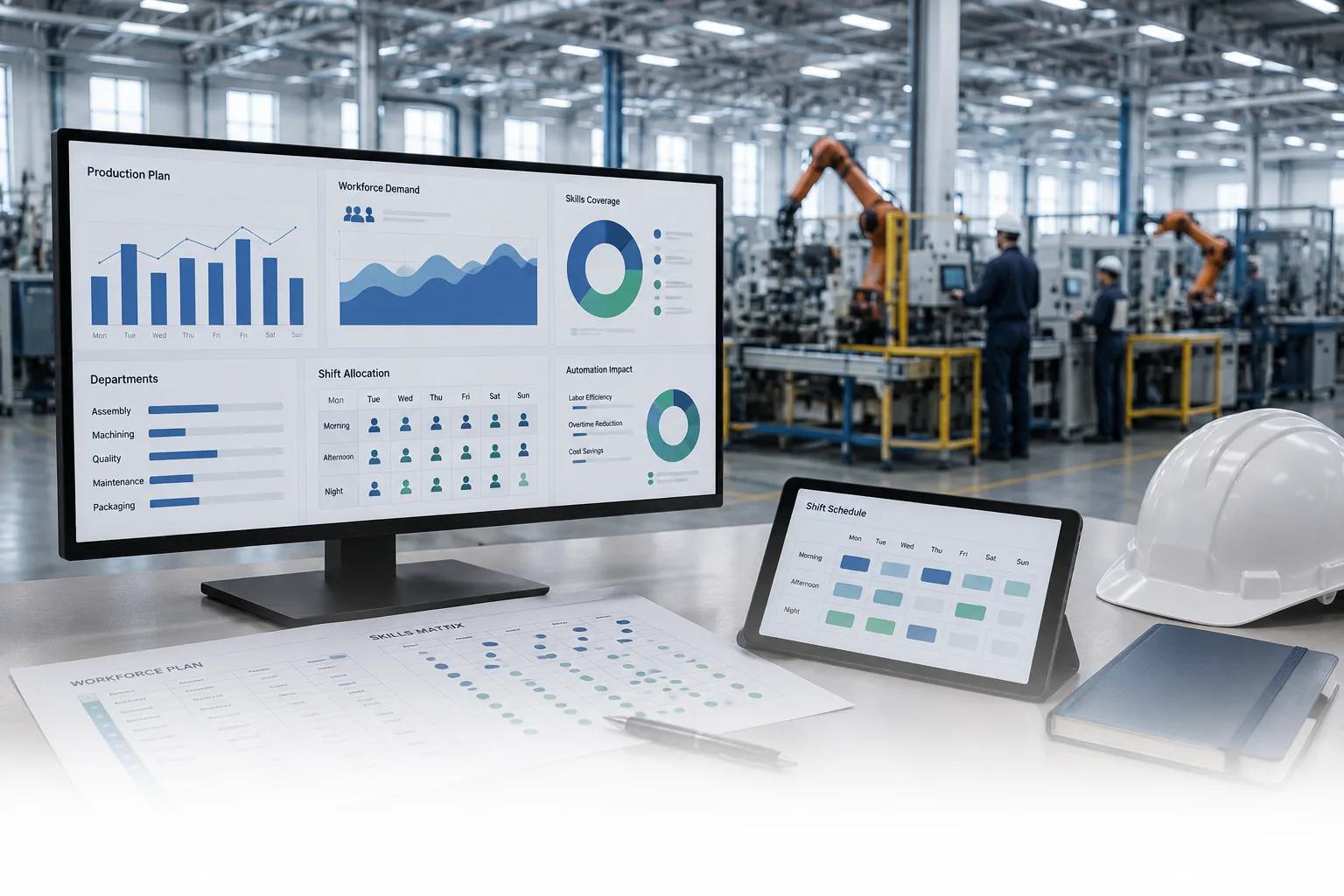
Industrial workforce planning links S&OP production targets directly to labor demand through the Industrial Workforce Causality Chain: S&OP Plan → Workforce Demand → Skills → Shift Coverage → Workforce Cost → Overall Productivity → Business Growth.
Translating production targets into direct labor headcount relies on Standard Allowed Minutes (SAM)—the engineered baseline required to complete one unit. Daily Line Output is calculated as:
Daily Line Output = (Shift Hours × 60 mins × Operators Assigned × Line Efficiency %) ÷ Product SAM
Planners must calculate Net Available Productive Hours by deducting operational leakages (leaves, training, downtime). For example, 4,400 monthly scheduled hours minus 500 hours of leakages leaves only 3,900 productive hours—a gap that forces emergency overtime if unmeasured.
Attendance Volatility, The Bradford Factor, & Unplanned Absenteeism Cost Metrics
Unplanned absenteeism costs industrial facilities $3,600 (SAR 13,500+) per worker annually in lost throughput and friction, with replacement workers operating at 30% lower productivity. Total unplanned absence costs reach up to 36% of base salaries.
To measure attendance volatility, operations leaders deploy the Bradford Factor formula (B = S² × D), where $S$ is the number of absence spells and $D$ is the total days absent. A single 10-day spell yields 10 points, whereas 10 individual 1-day absences yield 1,000 points—highlighting how short repeated absences disrupt shop-floor stability far worse than continuous leave.
To shield lines against volatility, smart plants establish flexible Float Pools (cross-trained operators dynamically deployed daily) and pre-approved Standby Pools.
The ILUO Behavioral Skills Matrix & Cost Engineering (Direct vs. Indirect Labor)
Eliminating Single-Qualified-Operator Risk requires a behavioral Skills Matrix compliant with IATF-16949 audit standards using the ILUO framework:
Plants with a Flex Ratio (operators qualified on ≥2 critical tasks) above 60% seamlessly absorb absenteeism. Financially, Direct Labor (DL) is treated as pure variable cost (COGS), Indirect Labor (IL) as semi-fixed overhead (MOH), and Staff as fixed period expenses.
Saudi Vision 2030, Future Factories SIRI Readiness, & WFM-MES Capability Lockout
Under Saudi Vision 2030, the Ministry of Industry's Future Factories Program targets 4,000 plants for digital transformation using the Smart Industry Readiness Index (SIRI), offering SAR 300,000 grants (80% software cost) and SAR 40M SIDF financing. Evaluating labor efficiency requires comparing OEE (equipment availability) vs OOE (Overall Operations Effectiveness) which incorporates human labor scheduling gaps.
Connecting Inspira One HCM by Tidal with MES enforces automated Capability Lockout—automatically locking machine control panels if an uncertified or expired operator attempts to log in. TechCraft Manufacturing achieved a 7:1 ROI ($495,500 net gain) in 12 months using integrated WFM skills matrix automation.